Article Plan: Safety First Thermometer Instruction Manual
This comprehensive manual details the Safety First thermometer’s operation, safety protocols, and maintenance. It covers everything from initial setup and accurate measurement techniques to troubleshooting and regulatory compliance, ensuring user well-being.
Welcome to the Safety First Thermometer – a precision instrument designed for rapid, non-contact temperature measurement. This thermometer, specifically the Sensitec NF-3101 model, is engineered for both adults and children, focusing on forehead and temporal artery readings. It’s a vital tool for proactive health monitoring in diverse settings, from homes to workplaces.

This manual serves as your complete guide to understanding and utilizing the thermometer’s capabilities effectively and safely. We prioritize user safety and accurate results, and this document outlines essential instructions for optimal performance. The device is intended for initial screening and should not be used as a substitute for professional medical diagnosis.
Understanding the importance of reliable temperature readings is paramount, especially considering the significant costs associated with work-related injuries and illnesses – estimated at nearly $1.2 trillion nationally in 2022 by the National Safety Council. Proper use, as detailed herein, contributes to a safer environment and informed health decisions. Remember to always refer to this manual before each use.

Understanding the Importance of Safety
Prioritizing safety when using the Safety First Thermometer is crucial for accurate readings and preventing potential harm. While designed for ease of use, adherence to outlined precautions ensures both user and subject well-being. Ignoring safety guidelines can lead to inaccurate temperature assessments, potentially delaying appropriate medical attention.
The Occupational Safety and Health Administration (OSHA) emphasizes a proactive approach to workplace safety, and this extends to the use of medical devices like thermometers. Integrating safe practices, alongside existing programs like lockout/tagout and PPE protocols, minimizes risks. The National Safety Council highlights the immense financial and personal costs of preventable incidents, reinforcing the need for diligence.
This thermometer is not intended for diagnostic purposes; it’s a screening tool. Always consult a healthcare professional for definitive diagnoses. Careful reading of this manual, understanding error codes, and proper cleaning/disinfection are fundamental safety components. Remember, a safe user is an informed user, contributing to a healthier and more secure environment.
Key Features of the Thermometer
The Safety First Thermometer boasts several key features designed for reliable and convenient temperature measurement. Its non-contact design, utilizing infrared technology, minimizes the risk of cross-contamination, a significant advantage in various settings. It’s specifically engineered for forehead and temporal artery measurements, catering to both adults and children.
This model, similar to the Sensitec NF-3101, offers rapid readings, providing results within seconds. The digital display ensures clear and easy-to-interpret results, reducing the potential for errors. It incorporates an automatic shut-off function to conserve battery life, and features a user-friendly interface with simple button operation.
Furthermore, the thermometer includes audible and visual alerts for fever detection, enhancing its utility as a screening tool. It’s lightweight and portable, making it suitable for home use, healthcare facilities, and workplace screenings. The device’s memory function allows for recall of previous readings, aiding in tracking temperature trends.
Intended Use and Applications
The Safety First Thermometer is primarily intended for the non-invasive measurement of human body temperature. It’s designed for intermittent use, meaning it’s not meant for continuous monitoring, and serves as a screening tool to identify individuals who may have a fever. Its applications span a wide range of environments, including homes, schools, daycare centers, and workplaces.

In healthcare settings, it can be utilized for initial temperature assessments, assisting in rapid triage and infection control. Workplace safety programs can leverage the thermometer for employee health screenings, contributing to a safer work environment, especially considering the significant costs associated with work-related injuries and illnesses – estimated at nearly $1.2 trillion in 2022 by the National Safety Council.
The device is suitable for use on individuals of all ages, from infants to adults, making it a versatile tool for families and healthcare professionals alike. It’s particularly useful in situations where contact thermometers are impractical or pose a hygiene concern. However, it’s crucial to remember it’s a screening tool and not a substitute for professional medical diagnosis.
Safety Precautions ― General
Prior to using the Safety First Thermometer, carefully review all instructions within this manual. This device is intended for body temperature measurement only; do not use it for any other purpose. Keep the thermometer out of reach of children when not in use to prevent accidental ingestion or misuse. Avoid dropping the thermometer or subjecting it to strong impacts, as this could damage its internal components and affect accuracy.
Do not attempt to disassemble or modify the thermometer. Any unauthorized alterations will void the warranty and may create a safety hazard. Ensure the thermometer’s lens is clean and free from debris before each use to guarantee accurate readings. Be mindful of potential interference from external factors like direct sunlight or extreme temperatures, which can influence results.
This device is not a substitute for professional medical advice. If you have concerns about your health, consult a healthcare provider. Adhering to OSHA’s safety and health guidelines, and integrating workplace safety programs like lockout/tagout, are crucial for overall well-being, mirroring the importance of safe thermometer usage.
Electrical Safety Considerations
The Safety First Thermometer is a low-voltage device, but certain electrical safety precautions must be observed. Always inspect the battery compartment for signs of corrosion or damage before installing or replacing batteries. Use only the specified type of batteries as indicated in the ‘Battery Installation and Replacement’ section of this manual; incorrect batteries can pose a leakage risk.
Never expose the thermometer to excessive moisture or immerse it in liquids. Water or other liquids can cause short circuits and damage the internal circuitry. If the thermometer becomes wet, immediately dry it thoroughly with a soft cloth before attempting to use it. Do not operate the thermometer if it exhibits any signs of electrical malfunction, such as sparking or unusual odors.
When replacing batteries, ensure the device is switched off. Dispose of used batteries responsibly, following local regulations for battery recycling. Remember that workplace safety, as emphasized by OSHA and the National Safety Council, extends to proper handling of all electrical devices, even low-voltage ones.
Handling and Storage Guidelines
To ensure the longevity and accuracy of your Safety First Thermometer, proper handling and storage are crucial. Avoid dropping, striking, or subjecting the device to strong impacts, as this can damage the internal sensors and affect its performance. Handle the thermometer with care, avoiding excessive force when pressing buttons or adjusting settings.
Store the thermometer in a cool, dry place, away from direct sunlight, extreme temperatures, and humidity. Ideal storage conditions are between 15°C and 30°C (59°F and 86°F). Do not store the thermometer with or near corrosive materials or flammable substances. When not in use, keep the thermometer in its protective case or a similar storage container to prevent dust accumulation and accidental damage.
Regularly inspect the thermometer for any signs of physical damage, such as cracks or broken parts. Following these guidelines, aligned with general workplace safety practices promoted by organizations like OSHA and the National Safety Council, will help maintain the thermometer’s reliability and accuracy over time.
Preparing for Use ― Initial Setup
Before using your Safety First Thermometer for the first time, a few simple setup steps are required to ensure accurate and reliable readings. Carefully unpack the thermometer and all included accessories, verifying that nothing is damaged. Inspect the device for any visible defects before proceeding.
If battery installation isn’t pre-performed, refer to the ‘Battery Installation and Replacement’ section of this manual for detailed instructions. Ensure the batteries are inserted with the correct polarity. Power on the thermometer and familiarize yourself with the display and its various indicators. Perform a self-test, if available, to confirm the thermometer is functioning correctly.
Prior to taking measurements, clean the thermometer’s sensor according to the ‘Cleaning and Disinfection Procedures’ outlined in this manual. This is vital for hygiene and accurate results. Understand the intended use – forehead or temporal – and select the appropriate mode on the device. Adhering to these initial steps, mirroring safety regulations, will optimize performance and contribute to a safe user experience.
Cleaning and Disinfection Procedures
Maintaining a clean and disinfected Safety First Thermometer is crucial for preventing cross-contamination and ensuring accurate temperature readings. After each use, and especially when shared between individuals, the thermometer’s sensor must be thoroughly cleaned.
Use a soft cloth lightly dampened with a 70% isopropyl alcohol solution. Avoid harsh chemicals, abrasive cleaners, or immersing the thermometer in liquid, as this can damage the sensitive components. Gently wipe the sensor probe, ensuring all visible residue is removed. Allow the thermometer to air dry completely before storing or using it again.
For enhanced disinfection, particularly in healthcare settings, follow established infection control protocols. Regularly inspect the thermometer for any signs of damage that might compromise its integrity. Proper cleaning, aligned with safety regulations, not only protects users but also preserves the thermometer’s lifespan and reliability. Always prioritize hygiene for accurate and safe temperature measurements.
Battery Installation and Replacement
The Safety First Thermometer operates on standard batteries, ensuring portability and ease of use. To install batteries, locate the battery compartment, typically on the back or side of the device. Open the compartment cover, usually by sliding or pressing a release latch.
Insert the batteries, observing the correct polarity (+ and -) as indicated inside the compartment. Ensure the batteries are securely seated. Close the compartment cover until it clicks shut. When the display indicates low battery power, replace all batteries simultaneously with new ones of the same type.
Do not mix old and new batteries, or different types of batteries. Dispose of used batteries responsibly, following local environmental regulations. Incorrect battery installation can damage the thermometer and void the warranty. Regularly check battery levels to maintain consistent performance and accurate temperature readings. Proper battery management is essential for reliable operation.
Operating Instructions ‒ Step-by-Step Guide
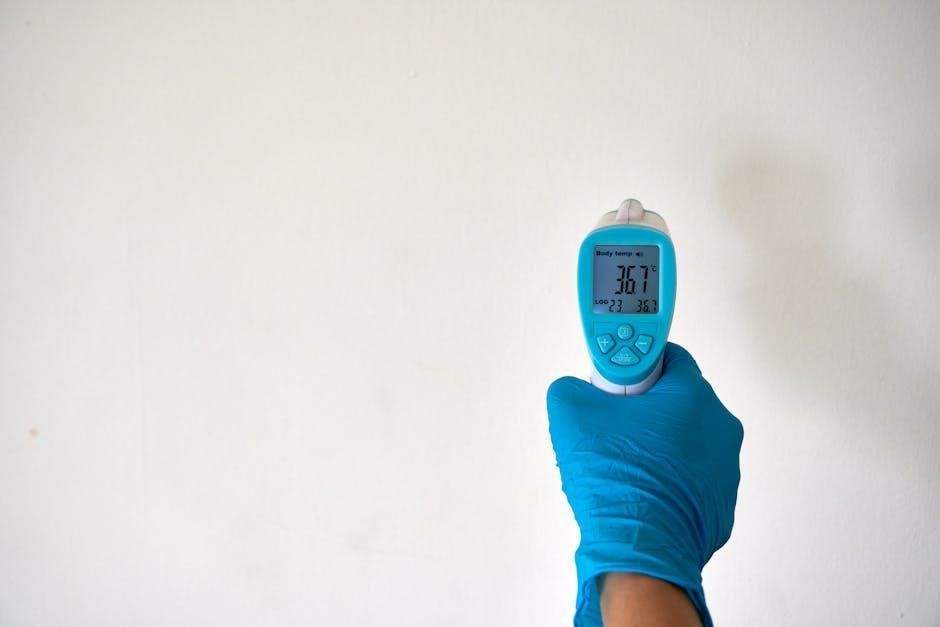
To begin, ensure the thermometer has fresh batteries and is powered on. Press the power button, typically located on the side, to activate the device. Allow a brief warm-up period for accurate readings. Select the desired measurement mode – forehead or temporal – using the mode button. For forehead measurements, position the thermometer centrally on the forehead, maintaining a distance of approximately 1-3 centimeters.
Press the scan button to initiate the measurement. The display will show the temperature reading within seconds. For temporal artery measurements, gently swipe the thermometer across the forehead, from the hairline to the temple. Again, press the scan button. The device will emit a beep indicating the reading is complete.
Review the temperature on the display. Press the memory button to recall previous readings. Power off the thermometer after use to conserve battery life. Always refer to the ‘Understanding the Display and Readings’ section for proper interpretation of results.
Measurement Techniques (Forehead & Temporal)
Forehead scanning requires positioning the thermometer centrally on the forehead, maintaining a consistent distance of one to three centimeters. Ensure the forehead is free from sweat, hair, or cosmetics for optimal accuracy. A stable hand is crucial; avoid movement during the scan. Press the scan button firmly to initiate the reading process. The device utilizes infrared technology to detect emitted heat.
Temporal artery measurement involves gently swiping the thermometer across the forehead, from the hairline towards the temple. Maintain contact with the skin throughout the swipe. This technique measures the temperature of the temporal artery, providing a core body temperature indication. The speed of the swipe should be consistent – neither too fast nor too slow.
Both methods offer non-invasive temperature assessment. However, external factors like ambient temperature and skin perfusion can influence readings. Always follow the ‘Operating Instructions’ for precise execution and refer to the ‘Understanding the Display’ section for interpretation.
Understanding the Display and Readings
The Safety First thermometer’s display presents temperature readings in Celsius or Fahrenheit, selectable via the unit button. A clear LCD screen indicates the measured temperature, alongside icons representing battery level, scan completion, and potential error codes. Normal body temperature typically ranges between 36.1°C (97°F) and 37.2°C (99°F), though individual variations exist.
A fever is generally defined as a temperature exceeding 38°C (100.4°F). However, consider factors like age and activity level when interpreting readings. The display may also feature color-coded indicators – green for normal, yellow for slightly elevated, and red for fever – providing a quick visual assessment. Consistent readings are vital; take multiple measurements to confirm accuracy.
Pay attention to any error messages displayed, referencing the ‘Troubleshooting’ and ‘Error Codes’ sections for guidance. Remember that readings are influenced by measurement technique and environmental conditions. Always consult a healthcare professional for diagnosis and treatment.
Troubleshooting Common Issues
If the Safety First thermometer displays an inaccurate reading, first ensure proper technique – maintain consistent distance and scan speed. Low battery power can also cause erratic results; replace batteries immediately. A dirty lens may interfere with accurate measurement; clean it gently with isopropyl alcohol.
If the device fails to power on, verify battery installation and polarity. Should the display remain blank despite new batteries, contact customer support. Consistent error codes indicate specific problems; consult the ‘Error Codes’ section for detailed explanations and solutions. Environmental factors, like extreme temperatures, can affect performance.
For intermittent readings, ensure a stable scanning motion and avoid direct sunlight. If issues persist, reset the thermometer by removing the batteries for 30 seconds. Remember, this device is a screening tool; always confirm results with a healthcare professional for definitive diagnosis and treatment. Do not attempt self-repair.
Error Codes and Their Meanings
The Safety First thermometer utilizes error codes to signal specific malfunctions. “Lo” indicates low battery power – replace batteries immediately for accurate readings. “Hi” signifies a temperature reading exceeding the device’s measurement range; ensure proper scanning distance and avoid extreme environmental temperatures.
An “Err” code generally points to a sensor malfunction or internal error. Attempt a device reset by removing and reinserting the batteries. If the error persists, discontinue use and contact customer support. Code “Pr” suggests a probe (if applicable) issue; verify secure connection or consider replacement.
A flashing display often indicates improper operation or interference. Ensure a stable scanning motion and avoid direct sunlight. Refer to the ‘Troubleshooting’ section for further guidance. These codes are designed for quick identification of problems, enabling efficient resolution and maintaining reliable temperature measurement. Ignoring error codes may lead to inaccurate results and compromised safety.
Maintenance and Calibration
Regular maintenance ensures the Safety First thermometer’s accuracy and longevity. Clean the sensor lens frequently with isopropyl alcohol and a soft cloth, avoiding abrasive cleaners. Store the device in a cool, dry place, away from direct sunlight and extreme temperatures. Avoid dropping or subjecting the thermometer to strong impacts.
Calibration is crucial for maintaining measurement precision. While this thermometer is factory calibrated, periodic checks against a known standard are recommended, especially in professional settings. If inconsistencies are detected, contact an authorized service center for recalibration. Do not attempt self-calibration, as this may void the warranty.
Proper care extends the device’s lifespan and guarantees reliable performance. Inspect the battery compartment for corrosion and clean if necessary. Following these guidelines contributes to consistent, accurate temperature readings and supports workplace safety standards, aligning with OSHA and NSC recommendations for reliable equipment.
Workplace Safety Integration
Integrating the Safety First thermometer into existing workplace safety programs is paramount. This includes incorporating its use into health screenings, particularly in environments where temperature monitoring is critical – such as food processing, healthcare, and manufacturing. Ensure all personnel are adequately trained on proper usage, cleaning, and reporting procedures.
Align thermometer protocols with established safety systems like lockout/tagout and PPE requirements. Document all temperature readings and maintain records for compliance purposes. Regularly review and update procedures based on feedback from workers and evolving safety standards, referencing OSHA guidelines and NSC recommendations.

Promote a safety culture where accurate temperature measurement is valued. This thermometer supports proactive health and safety measures, contributing to a reduction in work-related incidents and costs, mirroring the National Safety Council’s focus on preventing injuries and illnesses. Consistent implementation fosters a safer, more productive work environment.
Occupational Safety and Health Administration (OSHA) Resources
OSHA provides extensive resources relevant to workplace health monitoring, indirectly supporting the safe and effective use of the Safety First thermometer. While OSHA doesn’t specifically regulate thermometers, its guidelines on hazard identification, exposure control, and worker health surveillance are applicable.
Explore OSHA’s Safety and Health Topics pages for information on preventing illness and injury. These resources cover best practices for hygiene, infection control, and creating a safe working environment – all crucial when utilizing a device for temperature screening. OSHA’s enforcement information can help ensure compliance with general duty clauses related to worker well-being.

Leverage OSHA’s Learning Conversations and outreach programs to stay informed about evolving safety standards. Access guidance on implementing effective safety programs and promoting a safety culture. Remember that proper thermometer use, coupled with adherence to OSHA principles, contributes to a healthier and safer workplace, minimizing potential risks and supporting a productive workforce.
National Safety Council (NSC) Recommendations
The National Safety Council (NSC) champions workplace safety and offers valuable insights applicable to the implementation of temperature monitoring programs utilizing the Safety First thermometer. NSC data highlights the significant economic and personal costs associated with work-related injuries and illnesses – underscoring the importance of preventative measures.
NSC recommends a proactive approach to safety, emphasizing hazard recognition and risk mitigation. This includes establishing clear protocols for thermometer use, ensuring proper hygiene practices, and providing adequate training to personnel. Implementing a robust safety culture, as advocated by NSC, fosters employee engagement and promotes responsible behavior.
Consider NSC’s resources on health and safety management systems to build a comprehensive program. Focus on continuous improvement, data analysis, and regular safety audits. By aligning thermometer usage with NSC’s recommendations, organizations can demonstrate a commitment to worker well-being, reduce incident rates, and cultivate a safer, more productive environment, ultimately minimizing costs and maximizing efficiency.

Regulatory Compliance Information
The Safety First thermometer is designed to meet relevant regulatory standards for non-contact temperature measurement devices. While specific regulations vary by region and application, adherence to established guidelines is paramount. This includes compliance with standards related to electrical safety, electromagnetic compatibility (EMC), and accuracy of measurement.
Organizations utilizing this thermometer must ensure its use aligns with applicable Occupational Safety and Health Administration (OSHA) guidelines, particularly those concerning workplace health monitoring. Proper documentation of thermometer calibration, maintenance, and usage protocols is crucial for demonstrating compliance during inspections.
Furthermore, be aware of any industry-specific regulations governing temperature monitoring, such as those pertaining to food safety or healthcare. Regularly review updates to relevant standards and adjust procedures accordingly. Maintaining a clear understanding of these requirements ensures responsible operation and minimizes potential legal or operational risks, safeguarding both the organization and its personnel.
Warranty Information and Contact Details
Safety First provides a one-year limited warranty against defects in materials and workmanship from the date of original purchase. This warranty covers repair or replacement of the thermometer, at Safety First’s discretion, should a covered defect arise during normal use. Damage resulting from misuse, abuse, unauthorized modification, or accidental damage is not covered.
To initiate a warranty claim, please retain your proof of purchase and contact our customer support team. We require a detailed description of the issue and, if possible, photographic or video evidence to assist in the assessment process. Shipping costs for returning the thermometer may be the responsibility of the customer.
For technical support, troubleshooting assistance, or general inquiries, please contact us via:
- Website: www.safetyfirstthermometers.com (example)
- Email: support@safetyfirstthermometers.com (example)
- Phone: 1-800-SAFETY-1 (example)
Our customer support team is available Monday-Friday, 9 AM to 5 PM EST.